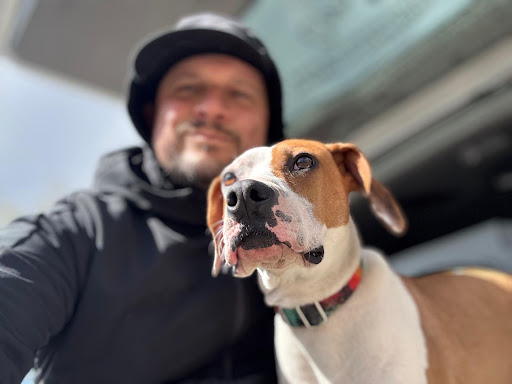
Rocky
- Hound/Pit Mix
- Rescue
- Male
- 2 Years Old
- 45 lbs

Rocky, a Beagle–Pit mix rescue, was far too reactive for any public spaces—triggered by dogs, people, bikes, and strollers even at long distances. We created a custom plan emphasizing de-escalation strategies, helpful reward sequences, clear communication, and loose-leash walking, and we proofed the skills around real-world triggers at parks and pet shops. With consistent practice, Rocky now can go out in public, relax more, make safer choices, while Lynda handles him with calm, confident control. Curious how we got there? Read the full success story to get a feel for how Lynda and I partnered together to help Rocky!

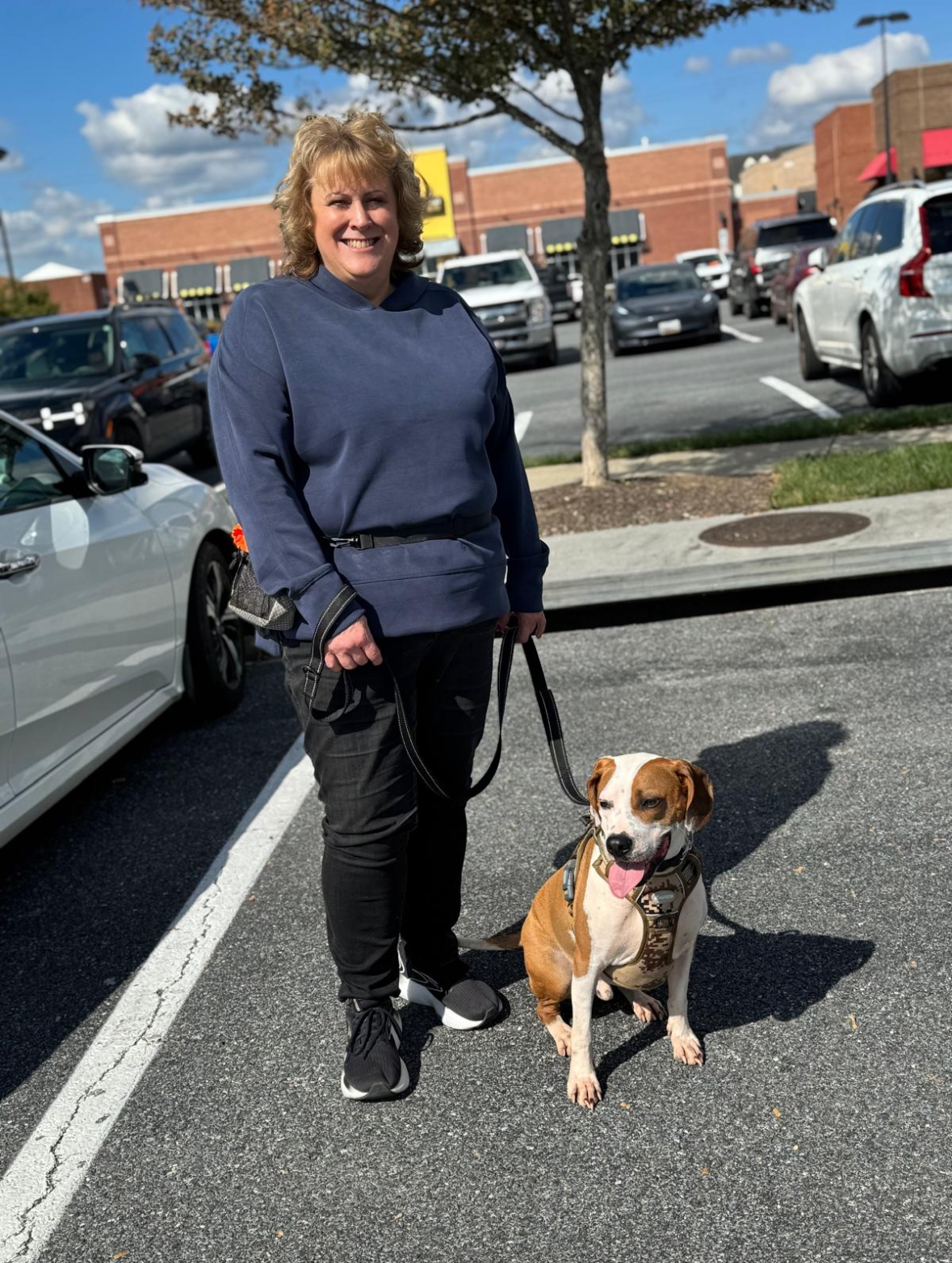
Rocky is a TANK OF A DOG for a 45lb-er. Without any initial training, it felt like you were walking a 90lb powerhouse. Even if never combined with his intense reactivity concerns, his leash-pulling strength was very problematic for Lynda (especially with upcoming knee surgery). I had to take this into account when developing a plan.
When I say “severely” reactive, I do mean severely (lashing out, launching, heavy barking/screeching, spinning erratically trying to get free from the leash, overall high intensity + his tendency towards what people call “trigger stacking,” where once he reacted intensely to the first trigger, he’d start immediately “looking” for the next trigger to react to). Rocky was a dog that, whether on a short line or a long line (as long lines often help ease a bit of stress for some dogs), would, to put it simply, spiral out of control… making walks and outings impossible. His athleticism and strength combined with his insecurities, stress, and hyper-awareness of everything in the environment all added up to chaos and unsafe scenarios. Every passing “trigger” was a dopamine hit for this guy, and he was really deep in that pattern before we started training. He needed a lot of thoughtful and safe exposure to the world, patience, and clear guidance as needed.
Our initial free hour-long evaluation went almost two hours because I really needed more time to get a feel for Rocky’s energy, as well as the really difficult experiences Lynda had had with him up to that point. I wanted to hear her concerns and where and when her biggest moments of anxiety with Rocky were taking place. Anyone reading this note who currently has (or has had) a heavily leash-reactive/leash-aggressive dog understands the anxiety and stress that come with that… and sometimes even shame and embarrassment for the owner. I wanted to make sure I could truly envision what was going on with Lynda, as well as Rocky.
Once Lynda approved the plan, we were able to get in two initial sessions prior to her surgery. After that, we had to come up with creative ideas to adapt and ensure Rocky would still get the training reps he needed to make good progress.
While Lynda was recovering from surgery, we adapted the plan creatively so I could take Rocky on a few social outings to Baker Park and eventually to a local pet shop. While he was with me, we did a lot of long-line de-escalation work around triggers, development of loose-leash walking, and overall adventuring/safe exposure in new spaces when not as many triggers were present.
To succeed in getting Rocky on a loose leash, due to his power and because his owner was recovering from knee surgery, it was my responsibility to give the best information I could to my client to help prevent him from going back to the shelter (which is where his reactivity and safety concerns were going to lead him if we didn’t step in). So I recommended, after a few sessions with Rocky, what I believed to be appropriate training tools that, when used thoughtfully and conditioned properly, would support both Rocky and his handler, Lynda, with peace of mind and safety.
The tools/supplies we used were initially a leather leash that was softer on the hands, a high-quality prong collar, and a high-quality e-collar as a back-up safety contingency when needed for guidance and communication.
If you’re reading this, you may know that people in the dog world can be very judgmental about different training tools like e-collars and prong collars, or even muzzles, slip leads, etc. The hard truth is that some dogs actually need certain training tools for safety reasons or other specific training needs. When certain “stigma’d” tools that are good quality and well-designed are in the right hands with someone who deeply cares about their dog’s success and spirit/personality, etc., it can be very helpful for reaching certain nuanced goals.
The other hard truth is that these tools can get in the hands of the wrong trainers or dog owners—people who lean heavily toward correction and control—which is, of course, why there is stigma around these tools. This is where a dog can become nervous about making mistakes and superstitious of various environments where they have been corrected at high levels on an e-collar (for example). That is not good, thoughtful training in my opinion… and if you see a trainer using the same exact training tool (like an e-collar) for almost every dog for every situation, rather than adapting to the actual needs/sensitivities of the dogs, I would personally run the other way.
A good saying that can be helpful for some of these clients—or maybe for you 🙂 (if you’re reading this far)—whose dog is possibly unsafe and creating unsafe scenarios, whether due to power, reactivity, and/or other intense “aggressive” behaviors:
“If someone gives me a hammer… with that hammer, I can choose to vandalize my neighbor’s home by breaking windows, etc… OR I can use that hammer to build my neighbor a shed or fix their fence, etc.”
So with Rocky—and of course, only with Lynda’s consent after we had discussed all the pros and cons—we chose to use a couple of tools safely, with purpose, and with care… not just to “control” Rocky or “punish” Rocky, as many people assume. Using them properly with Rocky, and taking the time to help him understand what they were, may have been one of the key difference-makers in whether Rocky would end up back in the shelter due to his significant safety concerns surrounding his reactive and high-intensity nature.
Once we made a great deal of tangible, observable progress with Rocky, we began to work on developing fluency (which was part of his custom Training Plan). During or after his training program, we never expected Rocky to be a robot; rather, we worked together to provide “proofing” scenarios where he had opportunities to make decisions that we could then reward heavily in fun, productive, Rocky-oriented ways, or give guidance on, depending on whether he chose to launch or keep space and offer de-escalating behaviors.
The way I train all of the dogs I work with is that we work together to help the dog learn to think more about their typical “trigger” scenarios… rather than micro-managing or controlling the dog’s actions/behaviors. The main variable we actually have to “control” throughout training is the dog’s safety, human safety, and the safety of any nearby triggers (person on bike, another dog, etc.). This is what we did with Rocky, patiently proofing the choices he was making, continuously building Lynda’s communication and guidance with him, and then building fluency through a developed reward system.
Rocky still gets somewhat excited about new environments with some “interest whining,” occasional quick spurts of barking (because he is not a robot… nor do we want him to be), but his reactivity is nowhere near what it used to be. Both Lynda and Rocky are safe, and Rocky did not have to go back to the shelter due to the chaos he’d create in those moments when he was around environmental triggers. Lynda has developed a great system of communication and expectations, while Rocky is making, more or less, 80% of his decisions with fun and encouraging confirmation from Lynda.
(as a support to our goals)
During our program, once we made a bit of tangible progress, we used my Australian Cattle Dog, Rip, during a session or two to help build healthy journeying and socialization with another dog. Lynda was also able to get Rocky socialized safely with her sister’s dogs as well.
Rocky is still, and always will be, a powerhouse of a dog who is highly interested in his surroundings and will make mistakes here and there… but thanks to Lynda’s commitment, her kind and consistent leadership, and our work together, he is so much safer, a better decision-maker, and much more socialized to his surroundings. Week by week, his world continues to open because Lynda has been such a proactive presence in his life!
Rocky was a case of extreme and powerful, unhinged environmental reactivity (even though his inherent disposition is very sweet and fun-natured). I’ve been around enough dogs to know that he is absolutely a dog who could have easily ended up back in the shelter had she not sought help… and I imagine this may have been the reason he ended up there in the first place when Lynda rescued him.
Lynda, if you read this, I’m so proud of all your hard work and how you have opened up Rocky’s world!
Amazing transformation – highly recommend John @ Confetti Dogs!
Working with John at Confetti Dogs has completely changed life for me and my dog, Rocky. Before training, Rocky struggled with leash, pulling barking, crate anxiety, and constant reactivity. I felt stuck and frustrated until John stepped in.
His calm positive and personalized approach made an immediate difference. John not only helped Rocky become more relaxed and focused, but also gave me the tools and confidence to handle any situation. He explains the “why” behind every technique and truly cares about both you and your dog.
Now, our walks are peaceful, and Rocky is happier than ever. If you’re looking for lasting results with a trainer who truly understands dogs, John is the best choice you can make!
Happy Dog Parent,
Lynda